Drone law
Drone in the Garden: Your Own Property and the Neighbours
Updated on 5 min read
Written with AI: This text was written with the help of artificial intelligence. Technical data and legal information are based on the linked manufacturer and authority sources. Learn more
Legal status checked on · not legal advice
Drones in the garden at a glance
| Question | Answer |
|---|---|
| Can I fly over my neighbours’ garden? | with a camera drone only with their explicit consent |
| Exception without consent? | drone up to 250 g that cannot record or transmit anything |
| Do I need insurance in my own garden? | yes, § 43 LuftVG has no garden exception |
| Do geozones apply in the garden? | yes, for example near airports |
| Can any drone fly in a residential area? | no, in A3 a distance of 150 m from built-up areas applies |
This page is not legal advice. It summarises the regulations and the information from the LBA and EASA. It does not cover neighbour disputes, damages or injunctions.
What § 21h LuftVO says about residential property
In Germany, residential properties are a geographical zone under § 21h(3) No. 7 of the Air Traffic Order (Luftverkehrs-Ordnung, LuftVO). Operation over residential property is only permitted if one of these conditions is met:
| Case | Condition under § 21h(3) No. 7 |
|---|---|
| a) Consent | The owner or other authorised user whose rights are affected has explicitly consented to the overflight. |
| b) Light drone without sensors | Take-off mass up to 0.25 kg, and the drone including its equipment cannot make or transmit optical or acoustic recordings and cannot record third-party radio signals. |
| c) At least 100 m altitude | only together with further conditions, see below |
For hobby flights in the garden, case c is practically no way out. Among other things, it requires that the overflight is necessary for a legitimate operational purpose, that no public areas can be used, that obtaining consent is not reasonably possible, that those affected are informed in advance, that there is no flying between 22:00 and 06:00, and that the noise guideline values are not expected to be exceeded.
In its FAQ, the LBA lists the same cases plus two more: operations by authorities with security tasks, where necessary, and an exemption from the responsible state aviation authority.
Flying in your own garden
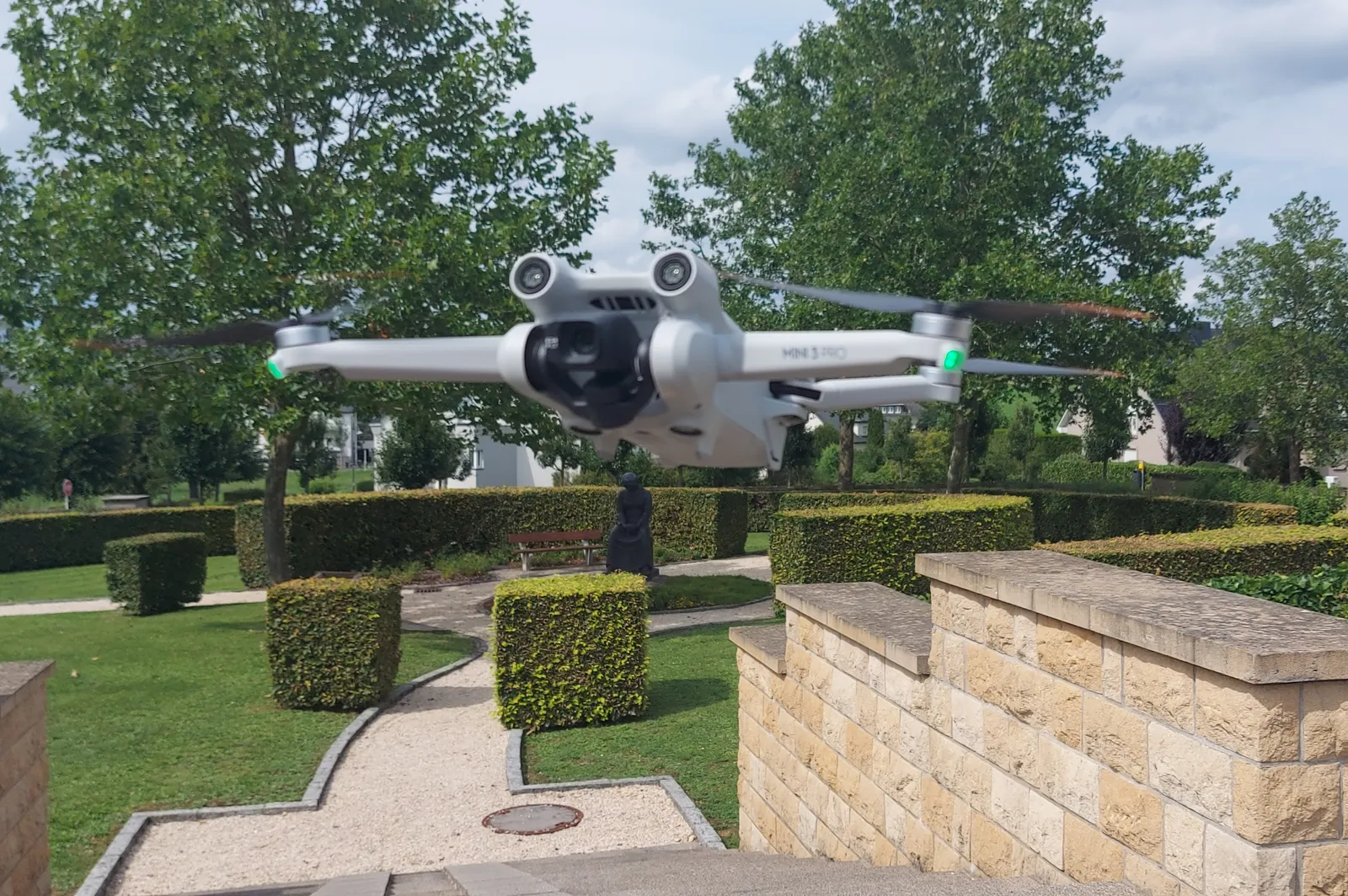
Over your own residential property, you are yourself the owner or authorised user. Consent under case a is then up to you. But that only settles § 21h(3) No. 7. Everything else still applies:
- Registration: Whether you have to register with the LBA depends on the weight and camera of the drone, not on the location. So the duty also applies in the garden. Details under Registration.
- Insurance: Under § 43(2) LuftVG, the keeper of an aircraft must maintain liability insurance. The provision names no exception for flights on your own property. More on this under Drone insurance.
- Other geozones: If your garden is, for example, near an airport or in another geographical zone under § 21h, their rules apply there as well. Which zones exist is explained under No-fly zones.
- Gardens next door: Gardens are often small. If the drone crosses the property line, you are over your neighbours’ residential property.
Not clear-cut: shared gardens. If you rent or live in an apartment building with a shared garden, there may be several authorised users. § 21h refers to the owner or authorised user “whose rights are affected”. The provision does not say explicitly whose consent you need in this case. If in doubt, get the consent of everyone affected.
Which drones may fly in a residential area at all?
The EU rules of the open category also apply in the garden. According to EASA, it depends on the subcategory:
| Subcategory | Drones | In a residential area |
|---|---|---|
| A1 | C0, C1, legacy drones and self-builds under 250 g | possible, do not fly over assemblies of people |
| A2 | C2 with A2 certificate | do not fly over uninvolved people, 30 m distance from uninvolved people, 5 m with low-speed mode |
| A3 | C3, C4, legacy drones and self-builds under 25 kg | 150 m distance from uninvolved people and from built-up areas (“urban areas”) |
An older drone of 250 g or more without a class label therefore flies in A3 and practically cannot take off in a built-up residential area. The EU classes page explains which class your drone has. For light models see Drones under 250 g.
Photos from the garden
For the overflight, § 21h is about whether the drone can make or transmit recordings, not whether you are filming at the moment. A camera drone therefore needs consent over the neighbours’ garden even when the camera is off. What applies when publishing footage that shows neighbours or their property is explained under Publishing drone photos.
Frequently asked questions
Is a verbal okay from the neighbours enough?
§ 21h requires that the person affected has “explicitly consented”. The provision does not prescribe a specific form. Written consent does, however, make it easier to prove later.
Can I fly a camera drone under 250 g over my neighbours’ garden without consent?
No. The exception for drones up to 250 g only applies if they cannot make or transmit recordings. Camera drones are therefore not covered.
My neighbour flies over my garden. What can I do?
Under § 21h, overflight with a camera drone without your explicit consent is not permitted, unless one of the cases above applies. The LBA FAQ does not say which authority you should contact in that case. This page does not cover civil-law claims; for those you need legal advice.
Can I fly in the garden at night?
For residential properties, § 21h only mentions the period from 22:00 to 06:00 in case c (from 100 m altitude). What else applies to night flights is explained under Night flying.
Sources
- § 21h Luftverkehrs-Ordnung: Geografische Gebiete, Abs. 3 Nr. 7 Wohngrundstücke (gesetze-im-internet.de), retrieved on 14 November 2026
- Luftfahrt-Bundesamt: Fragen und Antworten zu Drohnen (overflight of residential property, privacy), retrieved on 14 November 2026
- EASA: Open Category – Civil Drones (subcategories A1, A2, A3), retrieved on 14 November 2026
- § 43 Luftverkehrsgesetz: Haftpflichtversicherung (gesetze-im-internet.de), retrieved on 14 November 2026
Changes to this page
- : Page created.
- : Information checked against § 21h LuftVO, § 43 LuftVG, LBA FAQ and EASA. A3 distance adjusted to the EASA wording (built-up areas instead of residential areas), A3 weight limit corrected (under 25 kg), noise condition added to case c.