Accessories
Propeller guards for your drone: when they are worth it
Updated on 3 min read
Written with AI: This text was written with the help of artificial intelligence. Technical data and legal information are based on the linked manufacturer and authority sources. Learn more
Pros and cons
| Pros | Cons |
|---|---|
| Protects propellers on light contact | Additional weight |
| Lower risk of injury on contact | Shorter flight time |
| Good for practice and indoor flights | More surface for the wind to catch |
| Helps in tight spaces | Can change the EU class |
Propeller guards do not prevent a crash. They help with light contact with branches, walls or people. In a fast impact or a fall from a great height, they offer little protection.
Weight and C0: the most important point
Class C0 applies to drones under 250 g. According to the EU regulation, what counts is the maximum take-off mass (MTOM), and that includes the payload. So everything you attach to the drone counts.
Many mini drones are just under 250 g. A few grams of accessories are enough. An example from the DJI Mini 5 Pro manual:
| C0 version | C1 version | |
|---|---|---|
| Maximum take-off mass | 249.9 g (tolerance approx. ± 4 g) | 355 g |
| Propeller guard as approved accessory | no | yes |
For the C0 version, DJI writes: no payload except the parts on the accessory list, and the propeller guard is not on it. So with propeller guards, a C0 Mini 5 Pro is no longer C0-compliant. The rules for a heavier drone then apply to you, among other things you need the A1/A3 certificate (EU-Kompetenznachweis).
The same principle applies to other models: check the manual to see which parts are approved for your class. More on the weight limit under Drones under 250 g and EU classes.
Built in or added later?
Some drones are built with protection from the start. The DJI Flip has a foldable full-coverage guard, and for the DJI Neo 2, DJI gives separate values with propeller guards in the spec sheet. On these models, the guard is part of the design and the class. The comparison Neo 2 vs. Flip gives an overview.
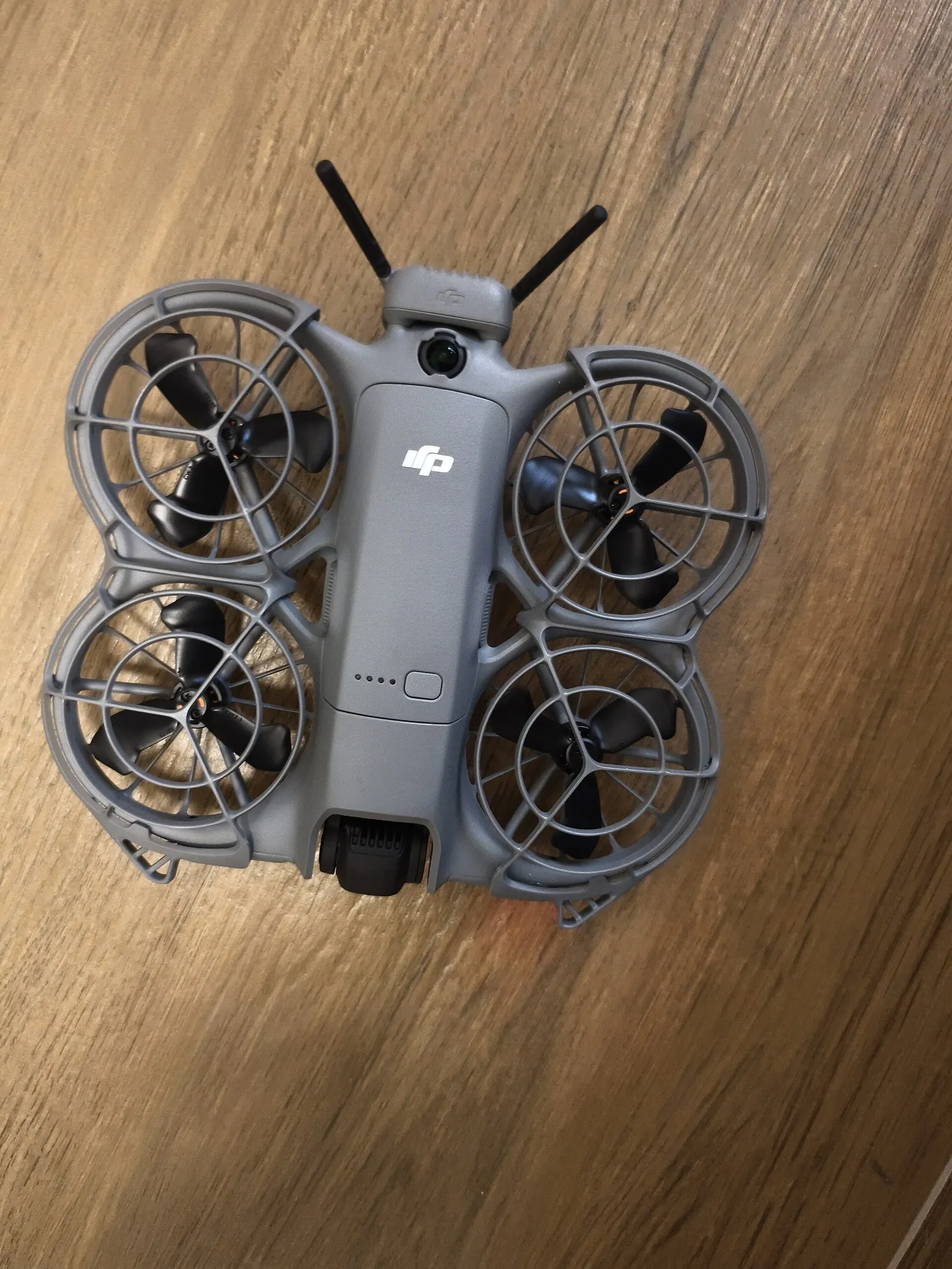
On other drones, the guard is a clip-on accessory. Here:
- Manufacturer accessories only. Third-party copies often fit poorly and are heavier.
- Fit them securely. A loose guard can get into the propellers.
- Check assistance systems. For the Mini 5 Pro, DJI writes that the “Nifty” avoidance mode does not work normally with propeller guards.
Who are propeller guards worth it for?
- Beginners practising their first flights in tight spaces. More on this under Learning to fly a drone.
- Children and families. Full-coverage protection makes particular sense here, see Drones for kids.
- Indoor flights or flights close to trees and buildings.
They make less sense for landscape flights over open ground and in wind. There, flight time and stability matter more.
Guards do not replace looking at the propellers themselves. When to replace them and which ones fit your drone is explained under Spare propellers.
Frequently asked questions
Do propeller guards shorten flight time?
Yes. More weight and more drag cost energy. How much depends on the model. Some manufacturers state a separate flight time with guards in the spec sheet.
Can I fly over people with propeller guards?
The guards do not change the rules for flying over people. What applies depends on your drone’s class. On a C0 drone, the guards can even worsen the class.
Do I need propeller guards for an FPV drone?
Small indoor FPV drones often already have rings around the propellers, see Tiny Whoop. On larger FPV drones, guards are rather unusual.
Sources
- DJI: Mini 5 Pro – User Manual v1.0 (PDF, English; MTOM explanation and C0/C1 accessory list, APAS), retrieved on 12 November 2026
- Delegierte Verordnung (EU) 2019/945, Art. 3 Nr. 28 (Commission Delegated Regulation, definition of MTOM) – EUR-Lex, retrieved on 12 November 2026
- EASA: Open Category – Low Risk – Civil Drones (class C0), retrieved on 12 November 2026
- DJI: Flip – Produktseite (product page; foldable full-coverage guard), retrieved on 12 November 2026
- DJI: Neo 2 – Technische Daten (specs with propeller guards), retrieved on 12 November 2026