Accessories
ND filters for drones: when they are worth it
Updated on 2 min read
Written with AI: This text was written with the help of artificial intelligence. Technical data and legal information are based on the linked manufacturer and authority sources. Learn more
What does an ND filter do?
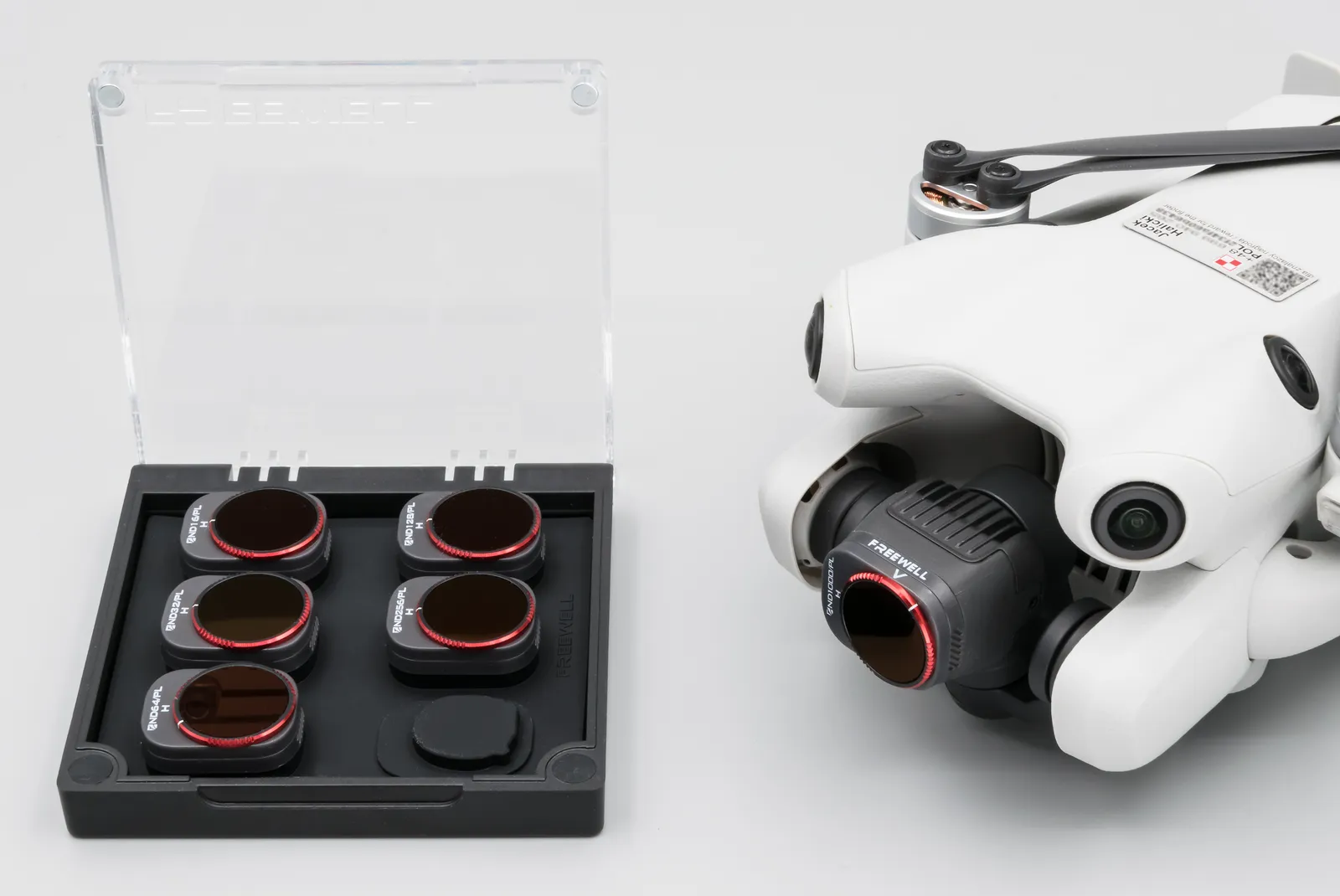
ND stands for “neutral density”. The filter works like sunglasses for the camera: it lets less light through without changing the colours. Drone cameras usually have a fixed aperture. In sunlight, the camera is then left with only a very short shutter speed. This makes video look choppy, especially with fast movement.
The 180-degree rule
A common rule of thumb from filmmaking: the shutter speed should be about 1 divided by twice the frame rate.
| Frame rate | Shutter speed by rule of thumb |
|---|---|
| 25 fps | 1/50 s |
| 30 fps | 1/60 s |
| 50 fps | 1/100 s |
| 60 fps | 1/120 s |
Without a filter, the shutter speed on sunny days is often far shorter, around 1/1000 s. With a suitable ND filter, you get back close to the rule of thumb.
Which strength do I need?
The number tells you how strongly the filter darkens. ND8 cuts three stops, ND16 four, ND32 five and ND64 six.
| Light | Rough guide |
|---|---|
| overcast | ND8 |
| slightly sunny | ND16 |
| full sun | ND32 |
| very bright, snow, water, beach | ND64 |
This is only a starting point. How much you need to darken depends on the camera, ISO and frame rate. Always check the exposure in the live view.
When you do not need an ND filter
- You mainly take photos. Here a short shutter speed actually helps against camera shake. Tips for photos are under Drone photo tips.
- You mostly film at dusk or in low light.
- You film slow motion at a high frame rate. The shutter speed is short anyway then.
Watch out with drones under 250 g
For class C0, the take-off mass must be under 250 g. Many mini drones are just below that. Accessories like filters or propeller guards add weight. Check with the manufacturer whether the filters are approved for your model, and preferably buy the filters the manufacturer offers for the drone. More on the classes under EU classes, and what applies under 250 g under Drones under 250 g.
Frequently asked questions
What is an ND/PL filter?
An ND filter with an additional polarising filter. The polariser reduces reflections on water and glass and makes the sky more vivid. The effect depends on the angle to the sun.
Do I have to change filters at take-off?
Yes, you swap the filter before take-off. If the light changes a lot, you have to land and change it. That is why many pilots carry several strengths.
Sources
- EASA: Open Category – Low Risk – Civil Drones (class C0), retrieved on 12 November 2026