Accessories
Landing pad for your drone: do you need one?
Updated on 2 min read
Written with AI: This text was written with the help of artificial intelligence. Technical data and legal information are based on the linked manufacturer and authority sources. Learn more
When a landing pad helps
| Surface | Landing pad useful? | Why |
|---|---|---|
| Sand, beach | yes | sand can get into the motors and gimbal |
| Tall grass | yes | blades of grass can block the gimbal and propellers |
| Gravel, dust | yes | small stones and dust get kicked up |
| Snow | yes | wet electronics, take-off point hard to see |
| Asphalt, paving | usually no | firm, clean surface |
| Short grass | rather no | good enough for most take-offs |
In the Mini 5 Pro manual, DJI warns about sand when taking off in the desert or on the beach. In addition, the gimbal motor can go into a protection mode if the drone is on uneven ground or on grass and the gimbal is blocked.
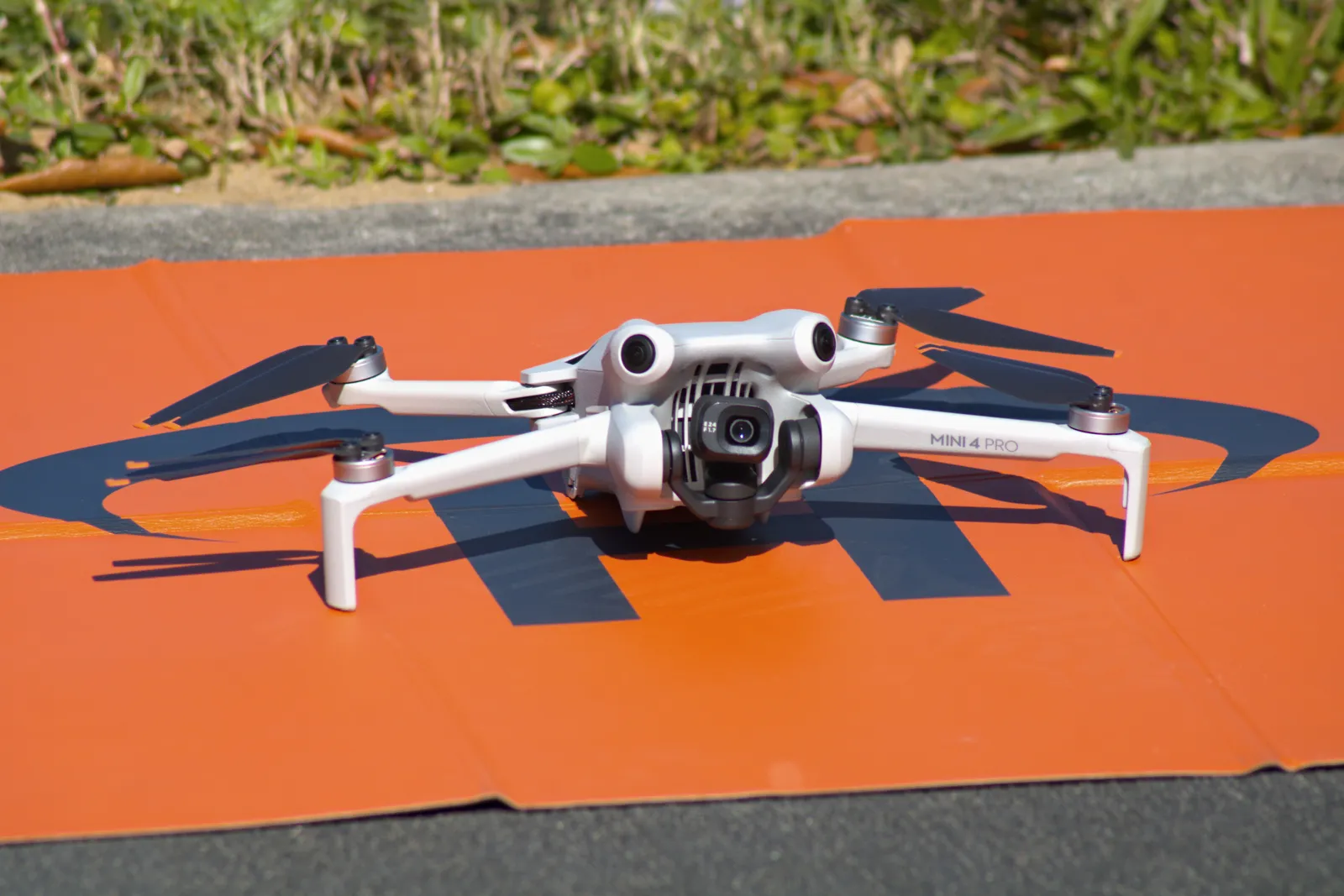
What to look for when buying
- Size. The pad should be clearly larger than your unfolded drone. That gives you room for error when landing.
- Pattern rather than plain colour. DJI advises against taking off from plain-coloured or highly reflective surfaces. A pad with a high-contrast pattern suits the sensors on the underside of the drone better than a plain surface.
- Anchoring. Pegs or weights keep the pad on the ground in wind. A light pad without anchoring can be lifted by the propeller downwash.
- Foldability. Most pads fold into a flat disc and fit in your drone backpack.
- Reversible. Two colours help you see the pad well on different surfaces.
Landing pad and precision landing
According to DJI, the Mini 5 Pro can use precision landing to touch down exactly at the take-off point. But this only works if the take-off point has distinctive features that hardly change during the flight. DJI explicitly names a snow-covered surface as unsuitable. A landing pad can help here, but does not guarantee precision landing. Watch the messages in the app.
What a landing pad does not replace
- A good take-off spot. Choose an open area with no people nearby. More on this in the Pre-flight checklist.
- The rules. Even with a landing pad, you have to respect geo-zones, see No-fly zones.
- Hand launch and hand landing. Some small drones are built for this. With other models it is risky.
Frequently asked questions
Can I just use a blanket or jacket?
Better not. Loose fabric gets pulled up by the propeller downwash and can get caught in the propellers.
Do I need a landing pad in winter?
It helps because the drone does not stand in the snow and the take-off point stays visible. What else to watch out for in the cold is explained under Flying a drone in winter.
Is a landing pad mandatory equipment?
No. It is a practical accessory, but not a requirement. Mandatory items include insurance and the e-ID, see Registration.
Sources
- DJI: Mini 5 Pro – User Manual v1.0 (PDF, English; take-off environment, gimbal, precision landing), retrieved on 12 November 2026