FPV
FPV Drone for Beginners: The Key Buying Criteria
Updated on 6 min read
Written with AI: This text was written with the help of artificial intelligence. Technical data and legal information are based on the linked manufacturer and authority sources. Learn more
The buying criteria at a glance
| Criterion | Recommendation for beginners |
|---|---|
| Weight | under 250 g |
| Size | Tiny Whoop for learning, Cinewhoop or 5-inch later |
| Package | Ready-made kit for an easy start, BNF if you already have a radio |
| Radio protocol | must match your radio |
| EU class | Has a class or was placed on the market before 2024, otherwise self-built |
We have not flown the drones mentioned here ourselves. Technical data comes from the manufacturers’ spec sheets.
Weight: under 250 g is ideal to start with
Light drones break less often in crashes and cause less damage. On top of that comes a legal advantage: under 250 g you do not need a drone pilot certificate (Kompetenznachweis), i.e. no drone licence. You still have to register, because FPV drones have a camera.
Pay attention to the take-off weight with battery. Some manufacturers state the weight without battery; the drone is then often much heavier when ready to fly.
Size: Tiny Whoop, Cinewhoop or 5-inch?
The size is usually based on the propeller diameter in inches.
| Class | Typical | Good for | Less good for |
|---|---|---|---|
| Tiny Whoop | very small, propellers in protective ducts | learning, flying indoors, crashes | wind, long flights |
| Cinewhoop | larger, propeller guards, often with a camera for good footage | smooth filming flights close to objects | tricks, racing |
| 5-inch | open propellers, lots of power | freestyle, racing, outdoors | beginners, flights near people |
For your first drone, a Tiny Whoop is the safest choice. What makes it special is under Tiny Whoop.
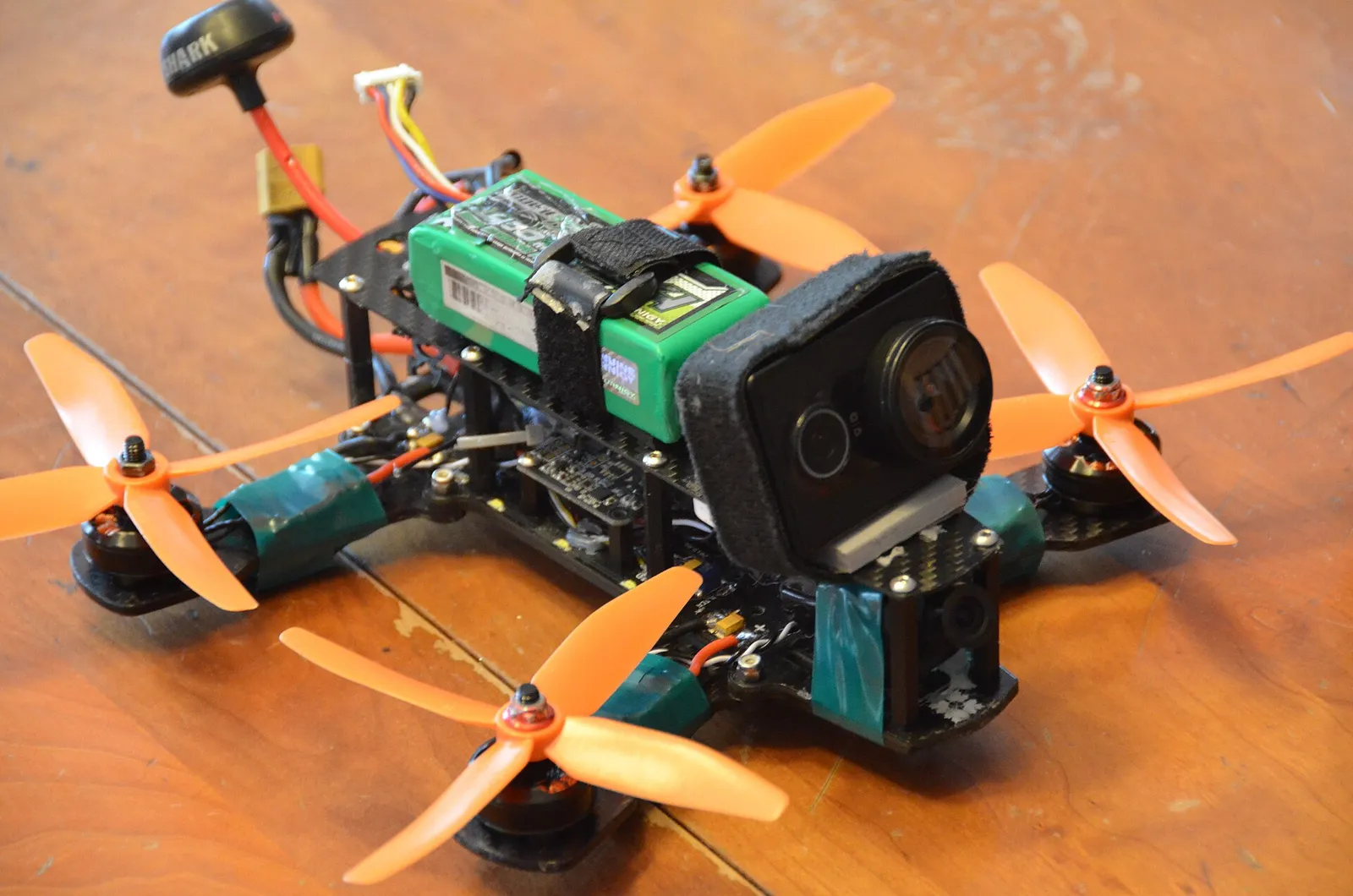
A 5-inch drone like this self-built racer is fast, powerful and usually over 250 g when ready to fly. Check the weight with the manufacturer. With open propellers, it is a big step for beginners.
Ready-made kit, BNF or PNP?
| Package | What is included? | Who it is for |
|---|---|---|
| Ready-made kit (RTF, “Ready to Fly”) | Drone, radio, often goggles and batteries | Beginners without their own gear |
| BNF (“Bind and Fly”) | Drone with receiver, without radio | you already have a matching radio |
| PNP (“Plug and Play”) | Drone without receiver | you install your own receiver |
A ready-made kit is the easiest, because everything works together. If you already have a radio from the simulator, a BNF drone is enough. PNP is more worthwhile for tinkerers who can solder.
Ready-made system example: DJI Avata 2
The DJI Avata 2 is a ready-made system with drone, goggles and controller from one manufacturer. According to the DJI spec sheet:
| Spec | DJI Avata 2 |
|---|---|
| Take-off weight | approx. 377 g |
| EU class | C1 |
| Dimensions (L×W×H) | 185 × 212 × 64 mm |
| Max. flight time | approx. 23 minutes (measured by DJI at a constant 21.6 km/h in a wind tunnel) |
| Flight modes | Normal, Sport, Manual |
| Max. speed in manual mode | limited to 19 m/s in the EU |
At 377 g it is over 250 g. You need the A1/A3 certificate for it. More on the model is under DJI Avata 2.
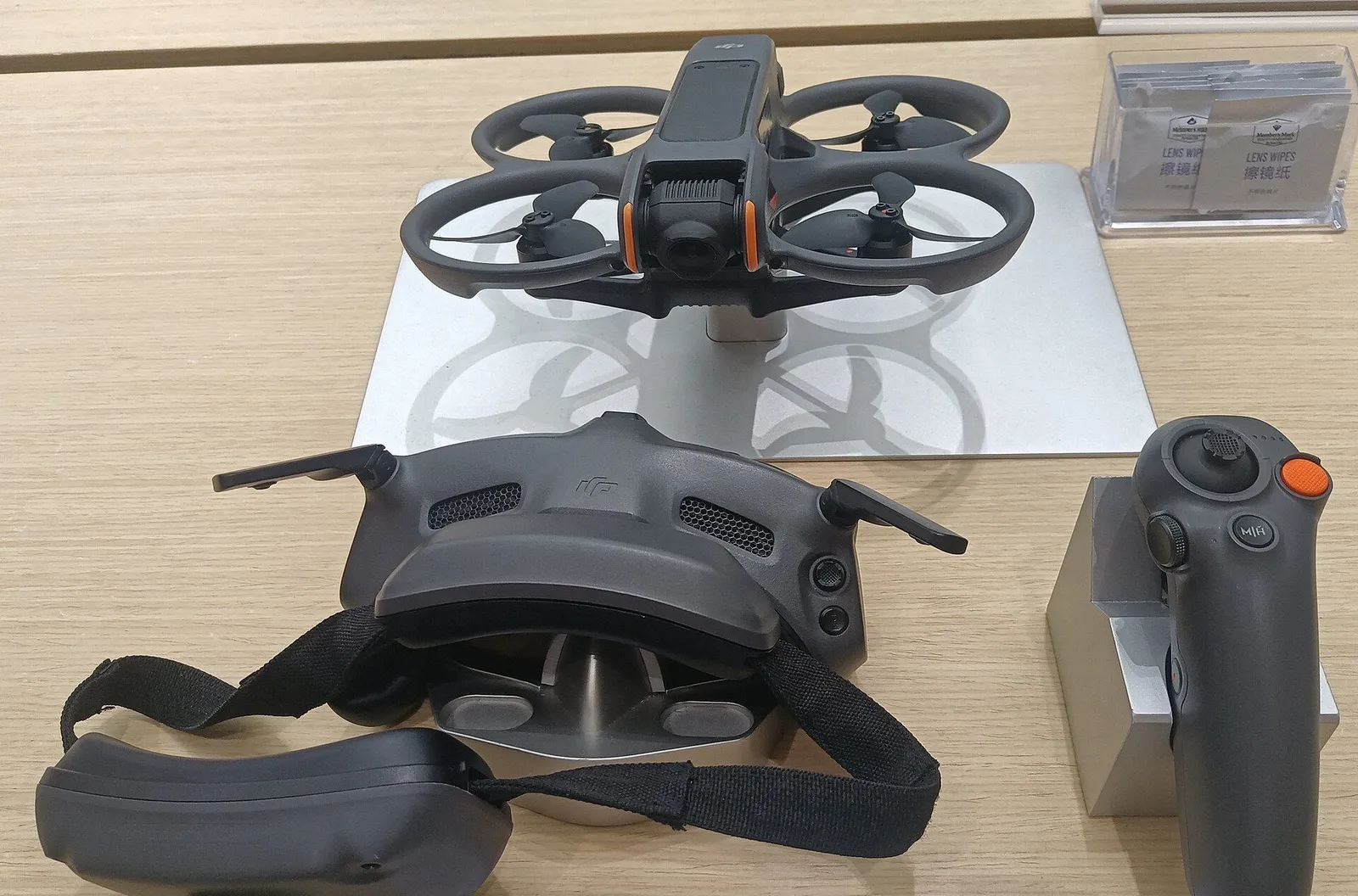
Radio protocol: radio and drone must match
With open systems, the radio connects to a receiver in the drone. Both must use the same radio protocol. One example is ExpressLRS, an open radio system that, according to its project page, works on 2.4 GHz among other bands. We explain radios, radio protocols and DJI controllers under FPV controller.
Here is how to proceed:
- Check which protocol your radio supports.
- Choose the BNF version of the drone with the matching receiver.
- With multi-band systems, make sure you use the frequency approved in your country. If in doubt, ask the manufacturer.
Ready-made systems such as the Avata 2 use the manufacturer’s own controllers, so this question does not arise there.
Legally important: check the EU class before buying
According to the LBA, since 1 January 2024 drones for the open category may only be placed on the market in the EU if they meet the requirements of EU Regulation 2019/945, i.e. if they have a class. For FPV drones without a class, this means:
| Drone | Open category |
|---|---|
| With class C0 or C1 | A1 |
| Without class, placed on the market before 1 Jan 2024, under 250 g | A1 |
| Without class, placed on the market before 1 Jan 2024, under 25 kg | A3 |
| Without class, placed on the market since 2024, purchased | according to EASA not an option in the open category |
| Self-built, under 250 g and max. 19 m/s | A1 |
| Self-built, under 25 kg | A3 |
Two points are especially important for beginners:
- A kit is not a self-build: According to EASA, a drone built from a purchased complete kit does not count as privately built.
- No class of your own: According to the LBA, as a private individual you may not apply a class marking to a drone.
According to the LBA, remaining stock without a class that came onto the EU market before 2024 may still be sold. Ask the retailer if the drone has no class. The full rules on observers, registration and insurance are under FPV rules, and we explain the classes under EU classes.
This page is not legal advice.
Frequently asked questions
Which FPV drone is best for beginners?
We do not make a specific recommendation here, because we have not flown the drones ourselves. To start with, a light drone under 250 g with propeller guards is a good fit, as long as it matches your radio and has a class or was placed on the market before 2024.
Can I fly a drone without a class indoors?
According to the LBA, registration, operational category and drone pilot certificate do not apply to operation inside buildings. Details under Tiny Whoop.
Do I need a licence for an FPV drone under 250 g?
No, under 250 g you do not need a drone pilot certificate in the open category. Outdoors you still need registration, insurance and an airspace observer.
Sources
- Luftfahrt-Bundesamt: Fragen und Antworten zu Drohnen (legacy drones, self-builds, class marking), retrieved on 12 November 2026
- EASA: Open Category – Low Risk – Civil Drones (privately built, kits, drones without class), retrieved on 12 November 2026
- DJI: Avata 2 – Technische Daten (specs), retrieved on 12 November 2026
- ExpressLRS: official project page, retrieved on 12 November 2026